Über Neumayer-Station III
About Neumayer Station III
Eine innovative Basis für die Antarktisforschung
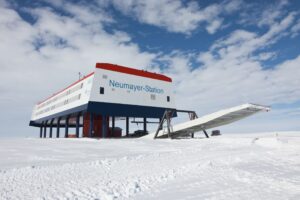
Das Alfred-Wegener-Institut betreibt trotz beschwerlicher Bedingungen in der Antarktis eine Forschungsstation, in der ganzjährig Wissenschaftler:innen leben und arbeiten: die Neumayer-Station III. Die Station auf dem Ekström-Schelfeis im atlantischen Sektor der Antarktis wurde 2009 in Betrieb genommen und ist die Basis für die deutsche Antarktisforschung.
Extreme Kälte, tobende Stürme und eine scheinbar endlose Polarnacht. Die Antarktis ist ein gefährlicher und faszinierender Ort zugleich. Ohne die richtige Ausrüstung ist die Eiswüste tödlich, doch sie birgt Datenschätze, mit denen wir unseren Planeten besser verstehen. Hier betreibt das Alfred-Wegener-Institut deshalb trotz beschwerlicher Bedingungen eine Forschungsstation, in der ganzjährig Wissenschaftler:innen leben und arbeiten. Seit 2009 dient die Neumayer-Station III auf dem Ekström-Schelfeis an der Küste des östlichen Weddell-Meeres als Basis für die deutsche Antarktisforschung.
Nur wenige Kilometer entfernt von ihren beiden Vorgängerstationen ist sie ebenfalls in der Atka-Bucht errichtet. Einst als Ausweichposition gedacht, hat sich die Lage der drei Stationen sowohl wissenschaftlich als auch logistisch bewährt. Mit dem Skidoo ist das Meereis in nur wenigen Minuten zu erreichen und Eisbrecher können an der Eiskante sozusagen direkt vor der Haustür anlegen. In einer Region, die selbst nach antarktischen Verhältnissen noch als dünn besiedelt gilt, führen die Observatorien an der Neumayer-Station III einzigartige Messreihen fort, die bis in die 1980er Jahre zurückgehen. Gleichzeitig kommen Jahr für Jahr neue Forschungsfragen hinzu und die Station ist Basis für Wissenschaftler:innen verschiedenster Disziplinen aus der ganzen Welt. Dabei dient sie auch als Ausgangspunkt für Expeditionen ins antarktische Hinterland.
Die Lage verlangt dem Bauwerk allerdings harte Bedingungen ab. Rund 40 Zentimeter schiebt sich das Schelfeis jeden Tag in Richtung Küste und gibt damit ein natürliches Verfallsdatum vor. In ferner Zukunft wird auch der Untergrund, auf dem die Station steht, als Eisberg abbrechen. Außerdem müssen Gebäude in der Antarktis einen endlosen Zutrag an Schnee aushalten. Die Neumayer-Station III passt sich in dieser Hinsicht jedoch optimal ihrer Umgebung an. Im Gegensatz zu den beiden Vorgängerstationen ist sie nicht mehr ins Eis gebaut und droht somit auch nicht, im Laufe der Zeit von den Schneemassen zerdrückt zu werden. Stattdessen ist die Station auf einer Plattform oberhalb der Schneeoberfläche errichtet und wird von 16 hydraulischen Stützen getragen. Regelmäßig heben Techniker das gesamte Gebäude an. So wächst es mit der Schneedecke und die Plattform liegt immer circa sechs Meter über dem Eis. Diese ausgefeilte Technik beschert der Station eine deutlich längere Lebenszeit – mindesten bis 2035 soll sie noch im Einsatz bleiben.
Die Neumayer-Station III ist die größte und komfortabelste Station in der Geschichte der deutschen Antarktisforschung. In den Sommermonaten finden hier rund 50 Personen Platz. Im Gegensatz zu den meisten anderen Forschungsstationen in der Antarktis beherbergt sie so gut wie alle Arbeitsflächen, Aufenthaltsräume und Vorräte zentral unter einem Dach. Und wenn die Station erst einmal ihr vorgesehenes Alter erreicht hat, kann sie bis auf die letzte Schraube rückgebaut werden, sodass die Spuren der Forschung in dieser schützenswerten Region so gering wie möglich bleiben.
An innovative base of operations for Antarctic research
The german research station Neumayer-Station III in the Antarctica
Despite the hostile environs, the Alfred Wegener Institute operates a research station in the Antarctic where scientists can live and work year-round: the Neumayer Station III. The station, which is located on the Ekström Ice Shelf in the Antarctic’s Atlantic sector and was founded in 2009, is the basis of German Antarctic research.
Extreme cold, raging storms, and the seemingly endless Polar Night – the Antarctic is as dangerous as it is fascinating. Without the right gear, the ice desert is deadly; yet it also contains essential data for better understanding our planet. Accordingly, the Alfred Wegener Institute operates a research station in the Antarctic where scientists can live and work year-round. Since 2009 the Neumayer Station III, located on the Ekström Ice Shelf on the coast of the eastern Weddell Sea, has served as the base of operations for German Antarctic research.
Located only a few kilometres from her two predecessors, the station is also near Atka Bay. Initially intended as a fall-back position, the area chosen for the three stations has since proven its value, both scientifically and logistically. The sea ice is only minutes away by Skidoo, while icebreakers can drop anchor at the sea-ice edge, virtually on the station’s doorstep. In a region that is sparsely populated even by Antarctic standards, the observatories at the Neumayer Station III continue unparalleled time series reaching back to the 1980s. At the same time, year after year there are new research questions to pursue, and the station serves as a hub for researchers from a broad range of disciplines and every corner of the world. In addition, it offers a point of departure for expeditions to Antarctica’s hinterland.
To fulfil that role, however, the station has to weather harsh conditions – every day, the ice shelf shifts roughly 40 centimetres closer to the coast, which means it has a natural expiration date. At some point in the distant future, the ground beneath the station will also calve off as an iceberg. In addition, buildings in the Antarctic have to withstand a constant supply of fresh snowfall. Yet in this regard, the Neumayer Station III is optimally suited for the local climate – unlike its two predecessors, it was not built into the ice, ensuring it can’t gradually be crushed by snow masses. Instead, the station sits atop a platform above the snow’s surface and rests on 16 hydraulic struts, which are used to raise the entire station on a regular basis. In this way, it can grow in step with the snow cover, ensuring the platform always stays ca. six metres above the ice. This approach translates into a substantially longer service life – until 2035 and possibly beyond.
The Neumayer Station III is the largest and most comfortable station in the history of German Antarctic research. In the summer months, it accommodates roughly 50 researchers and staff. Unlike most other research stations in the Antarctic, nearly all working areas, accommodations and storerooms are centrally located under one roof. And when the station finally reaches the end of its service life, it can be dismantled down to the very last nuts and bolts, ensuring the traces of the research conducted in this unique and vulnerable region are kept to a minimum.
-
4 Etagen Floors
mit einer Gesamtfläche von 4.890 Quadratmetern
with a total area of 4.890 square meters
-
118 Container Container
Die Station wurde aus 118 Containern erbaut und kann so auch wieder zurückgebaut werden
The station was constructed from 118 containers and can therefore be dismantled again
-
48 Betten Beds
-
40 cm cm
Rund 40 Zentimeter schiebt sich das Schelfeis jeden Tag in Richtung Küste
The ice shelf moves approximately 40 centimeters towards the coast every day
-
-50,2 Grad Celsius Degrees Celsius
Kälterekord am 8. Juli 2010
Record low temperature on July 8, 2010
-
42.000 Meter Meter
Elektrokabel
Electric cable
-
1.500 Meter Meter
Heizungsrohre
Heating pipes
-
63 Tage Days
Polarnacht
Polar night
-
14 Motorschlitten Snowmobile
sowie 2 Elektroschlitten für das Stationsumfeld
plus 2 electric sleds for the station environment
-
14 Pistenraupen Snow groomers